

Kimura
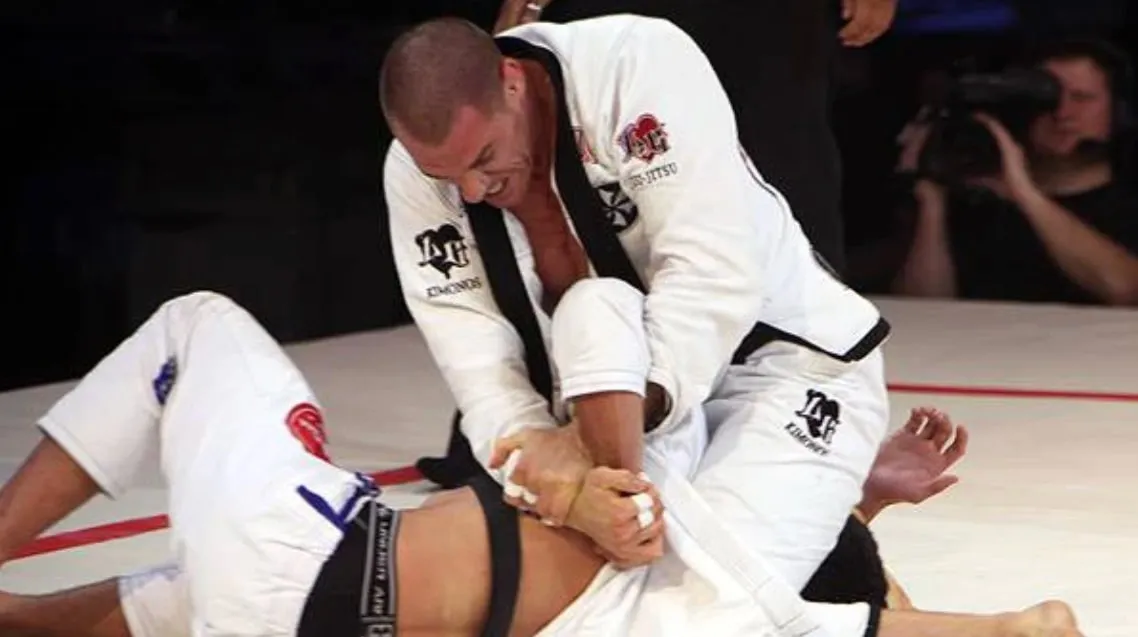
The Kimura is a shoulder lock that uses a figure-four grip to rotate the opponent’s arm behind their back, attacking the shoulder joint through internal rotation. It is one of the few techniques in Brazilian Jiu-Jitsu that works equally well as a submission, a sweep, and a control position — which is why it appears in the games of white belts and world champions alike.
What is the Kimura?
Section titled “What is the Kimura?”The Kimura attacks the shoulder. You take a figure-four grip — one hand on the opponent’s wrist, your other arm threaded under their upper arm to grip your own wrist — and rotate their forearm toward their feet and away from their body. The shoulder runs out of rotation before anything else does, and that is where the submission lives.
The grip is the technique. Without the figure-four, you are pulling on an arm with one hand against someone’s whole body. With it, you have both arms working against one of theirs, and a lever long enough to turn a shoulder that does not want to turn.
It is worth understanding the Kimura alongside its mirror image, the Americana. Both use a figure-four on a bent arm. The difference is direction: the Americana rotates the hand toward the opponent’s head, the Kimura toward their feet. Judo names them accordingly — ude-garami and gyaku ude-garami, “reverse” arm entanglement. Catch wrestling knows the same hold as the double wristlock.
Why it’s called the Kimura
Section titled “Why it’s called the Kimura”The name is Brazilian Jiu-Jitsu’s, and it commemorates a defeat.
On 23 October 1951, at the Maracanã stadium in Rio de Janeiro, the Japanese judoka Masahiko Kimura faced Hélio Gracie. In the second round Kimura secured gyaku ude-garami. Hélio refused to tap. Kimura broke the arm, and when Hélio still would not concede, his brother Carlos threw in the towel to stop the match.
The Gracies named the technique after the man who beat them with it. That is the part worth keeping: a lineage confident enough to honour an opponent in its own vocabulary.
Why is the Kimura Important in BJJ?
Section titled “Why is the Kimura Important in BJJ?”- It is available from almost everywhere. Closed guard, half guard, butterfly guard, side control, north–south, against a turtled opponent, and from underneath side control when you are supposed to be in trouble. Few submissions travel this well.
- The grip controls even when it doesn’t finish. A secured figure-four limits which way an opponent can turn. Many practitioners take the grip primarily to steer someone into a sweep or a better position, and treat the tap as a bonus.
- It punishes a specific, common mistake. Posting a hand on the mat to base is instinctive. Against someone hunting the Kimura, it is an invitation.
- It is legal at every belt. Under IBJJF rules the Kimura is permitted from white belt upward for adult competitors, unlike the leg attacks that open up later. A white belt can build a real game around it on day one.
- It chains. When the Kimura fails it usually fails into something else — an armbar, a sweep, a guillotine, or the omoplata from the same side.
Who is the Kimura Recommended For?
Section titled “Who is the Kimura Recommended For?”Beginners. It is mechanically forgiving. The grip is easy to understand, the finishing motion is slow, and the danger of hurting a partner by accident is lower than with faster joint attacks — provided you apply it gradually.
Guard players. From closed guard and half guard the Kimura is both an attack and a sweep entry, which makes it one of the highest-value grips available from the bottom.
Smaller practitioners. Two arms against one, with the whole body available to help, is exactly the leverage trade that suits a size disadvantage.
No-gi competitors. The Kimura needs no lapel, no sleeve, and no friction. Everything it requires is the opponent’s own arm, which is why it survives the transition from gi to no-gi better than most gi submissions.
Step-by-Step Guide to the Kimura
Section titled “Step-by-Step Guide to the Kimura”The version below is from closed guard, the most common entry.
Step 1: Create the angle
Section titled “Step 1: Create the angle”- Break their posture and get them leaning forward or reaching.
- Open your guard and shrimp your hips out to one side. You cannot Kimura someone while square underneath them — you need an angle to bring their arm across.
Step 2: Take the wrist
Section titled “Step 2: Take the wrist”- Grip their wrist with your opposite hand — right hand to their left wrist.
- Grip at the wrist, not the forearm. The closer to their hand, the longer your lever and the less strength the finish needs.
Step 3: Complete the figure-four
Section titled “Step 3: Complete the figure-four”- Thread your other arm over and under their upper arm.
- Grab your own wrist. That is the figure-four, and until it closes you have nothing.
Step 4: Isolate the arm
Section titled “Step 4: Isolate the arm”- Sit up or angle out so their arm comes away from their body.
- Bring your leg over their back if you can. This stops them rolling out, which is the escape you will meet most often.
Step 5: Finish
Section titled “Step 5: Finish”- Rotate their forearm toward their feet, keeping the elbow bent at roughly ninety degrees.
- Move slowly. The shoulder gives up range long before it gives up structurally, and your partner needs time to tap.
Three details separate a Kimura that finishes from one that stalls:
- Keep the Elbow Bent
A straightening arm is no longer a Kimura — it is an armbar. Switch attacks rather than fighting for a shoulder that has already escaped.
- Strip Their Anchor Grip
Their hand belongs nowhere near their own belt, lapel or shorts. Break that grip before you rotate, or you will simply be arm-wrestling their whole body.
- Rotate With Your Torso
Chest pressure beats arm strength. Turning your upper body rotates their shoulder far more reliably than pulling with your hands.
The same grip and the same finishing rotation, entered from side control rather than from guard:
Common Mistakes and How to Avoid Them
Section titled “Common Mistakes and How to Avoid Them”- Gripping the forearm instead of the wrist
- Problem: Shortens your lever and hands them the strength contest.
- Solution: Slide the grip down to the wrist before you rotate.
- Finishing square underneath them
- Problem: Without an angle their shoulder has room to follow the arm, and nothing loads up.
- Solution: Shrimp out and create the angle first. The finish is a consequence of position, not effort.
- Letting them grab their own belt or shorts
- Problem: Their arm is now anchored to their body and you are trying to lift both.
- Solution: Attack the grip immediately — peel the thumb, or use your leg to break their frame.
- Allowing the forward roll
- Problem: Rolling over the trapped shoulder relieves the pressure entirely and can put them on top.
- Solution: Block it with a leg over their back, or follow the roll and keep the grip. The Kimura survives being rolled if you stay attached.
- Cranking
- Problem: Fast rotation injures training partners. Shoulders do not tolerate speed.
- Solution: Apply gradually and give the tap time to arrive. Nobody improves from an injured partner.
Drills to Improve Your Kimura
Section titled “Drills to Improve Your Kimura”| # | Drill | Purpose |
|---|---|---|
| 1 | Figure-four grip, no resistance | Build the grip until it forms without thought |
| 2 | Closed guard entry, partner posting | Train recognising the posted hand |
| 3 | Kimura to sweep, sweep to Kimura | Learn the grip as control rather than only as a finish |
| 4 | Grip-strip drill | Practise breaking their belt or shorts grip before rotating |
| 5 | Roll-follow drill | Keep the figure-four while they roll forward |
Defending Against the Kimura
Section titled “Defending Against the Kimura”- Straighten the arm early. A straight arm cannot be Kimura’d. It can be armbarred, so straighten it and pull the elbow back toward your body.
- Grab your own belt, lapel or shorts before the figure-four closes. Anchoring the arm to your torso forces them to lift your whole body.
- Turn toward the trapped arm, not away. Turning away feeds the rotation.
- Roll forward over the trapped shoulder to relieve pressure — but expect good opponents to follow.
- Prevent it entirely: stop posting your hand flat on the mat when you are inside someone’s guard. Almost every Kimura from guard begins with that hand.
The Kimura in Competition
Section titled “The Kimura in Competition”The Kimura appears at every level of competitive grappling, in gi and no-gi alike, and it is a staple of MMA where it doubles as a control position against the cage.
Its competitive value is not only the tap. A figure-four grip dictates which way an opponent can turn, which makes it a way to force sweeps, take the back, and advance position — the grip earns points even when the submission does not arrive.
Conclusion
Section titled “Conclusion”The Kimura rewards patience over strength. Get the angle, take the wrist, close the figure-four, and rotate slowly — and the same grip that finishes matches also controls opponents you cannot yet finish.
Learn it early and it stays with you. Few submissions remain this useful from white belt to black.
Frequently Asked Questions
Section titled “Frequently Asked Questions”What is the difference between a Kimura and an Americana?
Section titled “What is the difference between a Kimura and an Americana?”Direction. Both use a figure-four on a bent arm, but the Americana rotates the hand toward the opponent’s head, while the Kimura rotates it toward their feet. As a rule of thumb from top position: if their arm bends toward their head, take the Americana; toward their hips, take the Kimura.
Is the Kimura legal for white belts?
Section titled “Is the Kimura legal for white belts?”Yes. Under IBJJF rules the Kimura is legal for adult competitors from white belt upward. Always check the ruleset of the specific event you are entering.
Is the Kimura dangerous?
Section titled “Is the Kimura dangerous?”Applied slowly, no more than any joint lock. Applied fast, it can damage the shoulder before your partner can tap — the shoulder has little warning range. Rotate gradually, every time.
Can I use the Kimura in no-gi?
Section titled “Can I use the Kimura in no-gi?”Yes, and it is one of the best no-gi submissions there is. It needs no grips on clothing, so it transfers directly.
What should I do when they grab their own belt?
Section titled “What should I do when they grab their own belt?”Break the grip before you rotate. Peel the thumb, drive your hip in to create space, or use a leg to lever the arm free. Rotating against an anchored arm is a strength contest you will usually lose.